This blog documents my attempt to drink a beer from every country in the world and every state in the United States.

Saturday, October 20, 2012

Country #26: Armenia

 
Beer: Zhigulyovskoye

Brewery: Beer of Yerevan, Yerevan, Armenia

ABV: 5.0%

Funny name, funny bottle.
Armenia is a place surrounded by places vastly different from it, and the Armenian people have long suffered for it. They are Apostolic Christians, living in mountains and valleys in the Caucasus. They are surrounded by Eastern Orthodox Georgians to the north, largely teetotaling Shia Muslim Azeris in the flat lands to the east (with whom they fought a nasty war during the late 80s and early 90s), militantly teetotaling Iranians to the south, and Sunni Muslim Turks to the west, who just happened to kill about a million and a half of them in the early 20th century and still haven’t apologized for it. 

Zagorka, from Bulgaria, didn't use any Cyrillic letters on its bottle, although Bulgaria uses the Cyrillic alphabet. Armenia has its own script, seen on the sign at right, but this beer uses Cyrillic and Latin alphabets on its bottle. Hmmmm.
Armenia is in a strategic location, at the crossroads of the Caucasus, between the oil of the Caspian Sea and the ocean lanes of the Black Sea, but has shorelines on neither. So, while these other countries, with their own acrimonious relationships with one another, started building pipelines in order to make a lira or a lari, the pipelines circumnavigated Armenia. Everyone else started cooperating and got richer for it, but Armenia wasn't invited to the party. 

Circumvented. Armenia is the little grey country in the middle without any pipelines running through it.
More woe: Armenia was part of the Ottoman Empire for centuries and part of the Soviet Union for 69 years. Its beloved national symbol, Mount Ararat, where Noah’s Ark supposedly ran aground as the flood receded, somehow wound up in Turkey when the borders were last established. Jesus. Sounds like the country could use a beer.

Similarly named beers hailing from (from left to right) Belarus, Lithuania, and the Russian cities of Kazan, Samara, and Irkutsk.
Since I can’t buy Armenia a beer, I bought an Armenian beer for myself. I found an oddly shaped bottle of something called Zhigulyovskoye, which is about as Armenian a name as Smith or Jones. Explanation: while Armenia was a part of the Soviet Union, it, along with all the other satellite republics that became independent upon its collapse, experienced Russification, in which Moscow sent its best and brightest to manage the Motherland’s factories and to make sure that everyone fell in line with the Kremlin’s grand plans. Branding was also not big in the USSR, so breweries around the country were all made to produce beers called Zhigulyovskoye (or some close variant thereof), even if the eponymous beers all tasted different. When the USSR collapsed, many breweries in the newly independent republics continued to make beer under that name. So there you have it.

A slightly more Armenian name surreptitiously hiding on the side of the bottle.
As far as pale lagers go, this one was pretty decent. It was hazy, thick, and yeasty, with a bit of a citrus flavor. The funny bottle is used by the brewer, Beer of Yerevan, for most of their products, which is why the bottle is imprinted with the word “Kilikia,” the far more Armenian-sounding name of another of their brands. I wonder how Armenians feel about this stuff. Is it too Russian-sounding for many proudly independent Armenians? Is that why they ship it over here? Anyone know?

Monday, October 15, 2012

Country #25: Bulgaria


Beer: Zagorka

Brewery: Zagorka Brewery, Stara Zagora, Bulgaria

ABV: 5.0%

Interesting: Bulgaria uses the cyrillic alphabet (what you otherwise might recognize as the Russian alphabet), but we don't see that on Zagorka's bottle. Clearly this one is marketed as an export.
A few years ago, finding a beer from Bulgaria in the United States probably would have been difficult. There isn’t a big Bulgarian diaspora here—for instance, in 2000 about 55,000 Americans identified themselves as Bulgarian, while Serbia, with a similar population to Bulgaria, was the ancestral home to 140,000 Americans. Most Americans probably couldn’t even conjure up a mildly offensive stereotype about Bulgaria, let alone find it one the map.

It's right here, dummy! This stuff is made in Stara Zagora, and, like every other Eastern European beer, the name Zagorka is a derivative of the name of the city in which it is made.
While other former Iron Curtain shut-ins were seeing an influx of tourists and investment dollars—think the Czech Republic—Bulgaria's economy advanced more slowly. Its economy is still largely based on agriculture, and growing grain at that (Bulgaria and bulgur share an etymology), and a heavy dependence on agriculture usually goes hand-in-hand with a developing economy. Nevertheless, by 2007 Bulgaria had done enough to merit a seat at the grown-up table of the European Union. Five years later a lot of the prestige of being a member of the EU has eroded, but at the very least Bulgaria’s inclusion allowed it to more easily export stuff to the EU’s trade partners. Like us!

The crown and the lions aren't just for showing off: they evoke the actual Bulgarian coat of arms. The red, white, and green color scheme is also appropriate.
And thus, as the geopolitical and economic stars aligned, the universe enabled me to quaff a big bottle of something called Zagorka, “The Taste of Bulgaria.” It was pretty good: a nicely hopped standard pilsner. However, someone should tell the fine, hard-working folks at the Zagorka Brewery that the Taste of Bulgaria is awfully similar to the taste of Croatia, the taste of Ghana, and the taste of the Netherlands.

Skip the brewery tour. Here's how it's done.
That’s because Zagorka is now owned by Heineken, as are seemingly half the world’s beers. They all taste mostly fine, but I’m not convinced that they’re not all made using the exact same recipe. If anyone would like to help me organize an international blind taste test of pilsners in green bottles, perhaps we can get drunk to the bottom of this.

Sunday, October 7, 2012

Country #24: Guatemala


Beer: Famosa

Brewery: Cerveceria Centro Americana, Guatemala City, Guatemala

ABV: 5.0%

Never heard of it. Also: Famous since 1896? So, did you start making it in 1896? Or did you start making it in 1880, but it took 16 years for it to become famous? C'mon people, let's be clear here!
Long is the list of establishments serving mediocre food advertised as “famous” or, even more braggadocious, “world famous.” You’re not world famous just because some guy from Russia came to Texas on business and enjoyed your barbecue enough to tell his friends back home about it. Brad Pitt is world famous. Your meat isn’t.

A map of corn production. Iowa is really getting it done here, but maize is native to Guatemala, still grows there, and has found a way into this beer. With negative results.
And yet, the Crap National Lager of Guatemala, Famosa—meaning famous—has fallen prey to this silly way of thinking. I can’t say I blame the marketers here: lots of Crap National Lagers from this part of the world aim to convey an air of superiority with lofty-sounding names. Hispaniola is home to Haiti’s Prestige and the Dominican Republic’s Presidente; Puerto Rico produces Medalla (medal); Costa Rica is home to Imperial; and neighboring Mexico bestows us with Corona (crown), which really is famous (it’s the top-selling imported beer in the USA and is exported to 170 countries), though not because it’s good.

What's wrong with Gallo?
Tell me: have you ever heard of Famosa Lager? No? I hadn’t either. My good friend Will, who lived in Guatemala for a while, also hadn’t heard of it, because the stuff is called Gallo (rooster) in Guatemala, but Famosa when it is exported. Why the switcheroo? Your guess is as good as mine. Did they think us gringos would mispronounce the name? Who knows. I think naming a beer after a rooster is dignified, but the folks down in Guatemala apparently disagree. 

I'm the cock of the walk, but I can't have a beer named after me?
As one might expect, this beer should probably stay obscure rather than gain the fame its name implies it deserves. Corn grows much better than barley in the warmer, wetter climate of Mesoamerica (the Mayans were fond of it, after all), so Famosa is loaded with corn and light on barley, which is much tastier in beer. The result is a dry, flat flavor and watery texture. Another country checked off the list, but little pleasure gained other than killing a few brain cells and cracking a few jokes at its expense. And in listening to this:


State #20: South Carolina


Beer: Patriot Pale Ale

Brewery: RJ Rockers Brewing Company, Spartanburg, South Carolina

ABV: 6.0%

Yes, I know how to pour a beer into a glass. Mr. Rocker takes the blame for this one.
I find it puzzling when people from the South claim a monopoly on patriotism and a love of America. They wrap themselves in the flag, telling us to “Never Forget” 9/11, yet they abhor the urbanity and elitism of New York and Washington without ever having come within five hundred miles of them. Some of these same “patriots” will also fight tooth and nail to preserve the use of the Confederate flag, either as part of a state flag or as a stand-alone symbol to be flown next to other less offensive banners. Guess what? Your beloved Stars and Bars is a symbol for a violent, treasonous movement that killed hundreds of thousands of people so that rich, lazy white people could sit on their porch and get richer while black people got whipped for picking cotton too slowly. Violent, racist, and lazy treason: how patriotic!

I couldn't find an explanation for the brewery's name anywhere. (The founder's name is Johnsen). When I think of southern rockers, I think of this and this, unfortunately.
So, when I saw that a beer from South Carolina’s RJ Rockers Brewing Company was called Patriot Pale Ale, I immediately though “what a bunch of asses!” I bought a six pack of the stuff and drove off, resolving to make fun of it.

I think I tasted four or five drops that were NOT handcrafted. Close enough, I guess.
The good news is that, upon doing a bit of research, I learned that the founder of the brewery is a Gulf War veteran from New Jersey who had relocated down south. So, while I still deride South Carolina’s political attitudes, I salute your service, both to our country and to the craft beer industry. Seriously. Thank you.

Far more enjoyable uses of foam.
The bad news is that all six of the beers were foamtastic. I admit that the six pack tipped over in the back seat of my car when I was driving home, but that’s happened to me dozens of times, and never has an entire six pack been rendered virtually undrinkable by such a tiny tumble, especially not after two weeks of settling in the fridge. I couldn’t pour more than an ounce of the stuff into a glass without a massive head building up over the top of the glass. While the flavor was good—it was nice and hoppy, like a West Coast pale ale—the experience was altogether negative. While haute cuisine chefs do some amazing things with foams, a pint needs no more than one inch of it, and certainly not six. If I hadn’t bought the stuff in Huntington Beach, I would have gone back to the store and asked for my money back.

Saturday, September 15, 2012

Country #23: Bolivia


Beer: Paceña

Brewery: Cerveceria Boliviana Nacional S.A., La Paz, Bolivia

ABV: 5.2%

Notice the mountains on the label. That should tell you something.
I recently enjoyed a bottle of Paceña, the most popular beer in Bolivia. It wasn’t bad for a Crap National Lager. It was very light, but had a decent level of hoppiness for a pale lager, and was more than a few steps above watery. Not great, but not bad. I’m continuously impressed by the fact that tropical republics with no longstanding tradition of brewing beer consistently produce beers that are far better than Budweiser. Besides, with the gold foil, I knew it had to be pretty good.

But enough about the beer. It’s time for science!

I'm the king of Bolivian Beer! It's not saying much, but look how awesome I am! This is also my third South American beer, and the third with this weird code on it (upper right of the photo).
My investigation began when I read the peculiar list of ingredients on Paceña’s label: water, malt, selected cereal (Cap’n Crunch? Rice Krispies?), hops, antioxydant 224 (sic). What on earth is antioxydant 224, and do I really want it in my beer? In this case, why not? Antioxidants in general are good things to have in our body. When oxidation happens to chemicals in our body, it releases another type of chemical called a free radical, which can in turn result in cellular damage and degradation. Antioxidants jump in and bind with these oxidizing agents, preventing the whole thing from happening.

It’s like this: Mr. Oxidizer, a notorious rake and womanizer, is at your friend’s wedding, which is taking place inside a cell in your body. He badly wants to dance with Miss Important Cellular Chemicals, and the prim and proper Miss Important Cellular Chemicals finds Mr. Oxidizer very attractive. But if they were to cut a rug together, it would be SCANDALOUS, and a massive brawl would eventually break out, ruining the wedding and destroying the banquet hall (aka the cell). But Miss Antioxidant steps in at the last minute and dances with Mr. Oxidizer, and since Miss Antioxidant is kind of a tramp anyway, nobody cares, and everybody goes about their business. Later on, they are seen going into Mr. Oxidizer’s room together.

Potassium metabisulfate. Doesn't she look kind of slutty?
Antioxidant 224 is also known as potassium metabisulfite. It interferes with important oxidation functions in some strains of yeast, fungi and bacteria (yes, oxidation can be bad, but all life also needs it to happen to some extent). When used in beer it basically helps sterilize the product from unwanted little baddies. But most brewers take care of this when they boil the wort, or the mixture of malted grain and water. Boiling not only kills the baddies, but it helps the bitter flavors from the hops become activated. Win-win.

This will almost certainly be the highest brewery I try for the blog. (Image from Google Earth).

So why is Cerveceria Boliviana Nacional using the stuff to make Paceña? Because La Paz, Bolivia’s capital and the location of the brewery, is located about 12,000 feet above sea level. At that elevation, air pressure is significantly lower than it is at sea level, and as a result water boils at a significantly lower temperature (in this case about 189° F, as opposed to 212° F at sea level). This happens because air molecules are able to evaporate and escape their liquid state more easily, as they have a less dense shield of air pressing down on them from above. But microorganisms don’t care about air pressure. Their cell walls are ruptured only by sufficiently high temperatures. Hence the potassium metabisulfate to knock out any of the little critters that aren’t bothered by 189 degree boiling water. SCIENCE.

SCIENCE.

And while we’re at it, let me dispel the rumor that people metabolize alcohol any differently at higher elevations (which would allow you to get drunk faster). Yes, you’ll have less oxygen in your blood, especially if you’re a lowlander visiting a place like La Paz, but oxygen doesn’t play into the metabolism of alcohol, so you won’t be affected. People in La Paz use drugs (coca leaves) to help dispel the negative effects of living at high elevation, rather than embellishing them. So good for them: they can have a Paceña without getting trashed.

Monday, September 10, 2012

Country #22: Croatia


Beer:  Karlovačko              

Brewery:  Karlovačka Pivovara, Karlovac, Croatia

ABV: 5.0%

...and by 8-6-09 we were in Croatia pounding this stuff. The Croatian words on the bottle there mean something to the effect of "crowned quality, old tradition." Thanks Google!
Karlovačko is a not-so-special beer with a very special place in my liver heart. It is one of the two most popular beers in Croatia, where my wife and I spent our honeymoon, and boy did we drink a bunch of the stuff then.

What else does one do when on a beautiful, tranquil, Mediterranean island (in this case Mljet)? Drink beer and play Scrabble. Obviously. 
Croatia’s borders are contorted into a weird, boomerang-like shape. One wing of the country covers miles and miles of beautiful Adriatic coast, with its requisite fresh seafood and concrete beaches covered with beautiful women dressed as if it were 1987 and hairy, hefty men dressed as if it was Gay Pride week in The Castro. This part of the country has a very Italian feel to it, and wine is the preferred beverage. That’s where we spent our time, and, despite the Speedos, it was stunningly gorgeous, and despite the popularity of wine, we drank beer.

The only thing atypical about this Croatian beach scene is that the chap here is wearing the largest men's bathing suit in the country. (Taken on the island of Rab)
The other wing of the boomerang extends inland, cramming itself between Slovenia, Bosnia, and Hungary. Seafood is out in favor of spicy meat stews, and beer is more popular than wine. I don’t know how people dress, as we didn’t travel to this part of the country, but I imagine that at least the men here have more clothes on.

Textbook-quality annotated map of Croatia and its environs. Really all you need to know.
The city of Karlovac (pronounced KarloVOTS) is smack-dab in between these two wings, at the joint of the boomerang. The beer made there, Karlovačko (pronounced KarloVOTCHko, and just meaning “from Karlovac”), is second in market share and pronunciation difficulty to Ozujsko, but after drinking gallons of both, I'd say Karlovačko is a hair better. It’s a standard pilsner, but a pretty good one. For the sake of Jaime and I being able to drink our fill of honeymoon nostalgia, I have to thank Heineken for purchasing a majority stake in the brewery, because otherwise I probably wouldn’t be able to get it at my local booze emporium. Thanks for owning everything, Heineken!

Pivo was one of about four words of Croatian I learned (it also means beer in Russian,  Ukrainian, and a slew of other Slavic languages). The only complete sentence I remember how to say is 'dva pivo, molim," which means "two beers please." Priorities, right?

Saturday, September 8, 2012

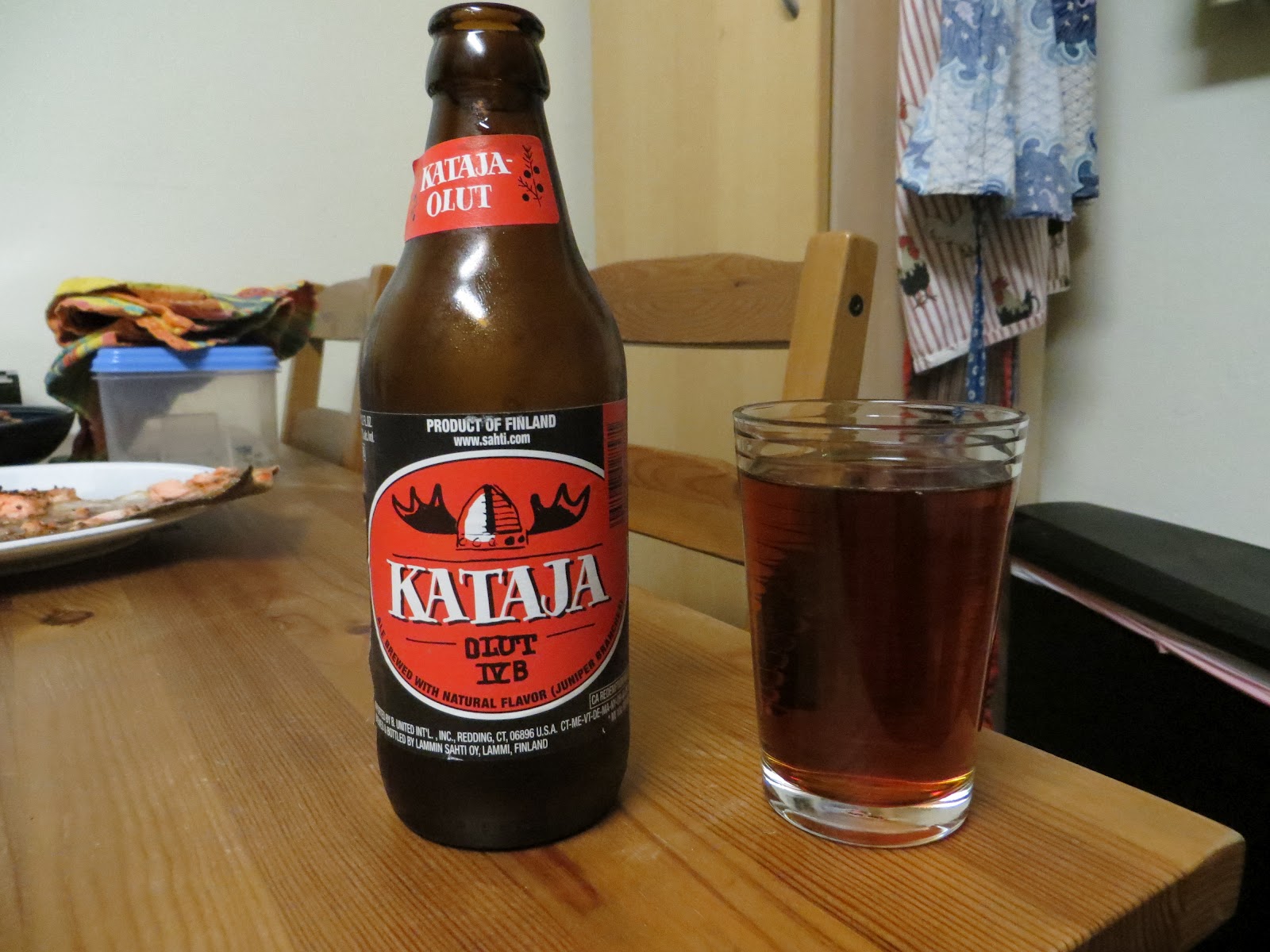
Country #21: Finland


Beer: Kataja Olut

Brewery: Lammin Sahti Oy, Lammi, Finland

ABV: 7.0%

Kataja Olut just mean 'juniper beer' in Finnish. I don't know the significance of the IV B. Gold star and a bottle of this stuff to anyone who can dig up the answer.
Finland does things a little bit differently than the rest of us. The Finnish language is a crazy mishmash of difficult vowel chains, like some bizarro Nordic version of Hawaiian. For example: Suomi on hyvin outo maa monia miellyttäviä valkoiset ihmiset, jotka haluavat istua alasti pienessä kuumassa huoneessa. 

Now here's a country that is secure in its masculinity. A little too secure, maybe.
Their national pastime is sitting naked in tiny hot rooms, and while they do enjoy baseball, just look at what they’ve done to it:


They also have a slightly different take on beer. Sure, regularly hopped beer is available for purchase in the country. But the traditional, national beer style, sahti, is a whole other animal. Since hops don’t grow well in the frigid glacial till near the Arctic Circle, boozehound Finns had to come up with some other kind of concoction that they could make with whatever they had lying around in their country.

Like this stuff (juniper branches and berries)
Sahti is still considered a beer because it is a yeast-fermented beverage made from malted grain. But the similarities end there. Most sahti doesn’t use any hops (though some use a pinch). Instead, the beer is flavored with juniper, just like gin. But it tastes nothing like gin; instead, it has a sweetish, highly tart and fruity flavor, to go along with a reddish brown color and very little carbonation. Those who enjoy sour beers might enjoy sahti, but it really is entirely different from anything else I’ve ever had. I liked it, but I can't foresee purchasing the stuff again, unless I somehow find myself in Finland.

No bottle cap design. Just an exorbitant price tag for a wacky Finnish beer (that's the price for one 11.2 ounce bottle).
The stuff I had was called Kataja Olut, and was made by Lammin Sahti Oy, the oldest commercial sahti brewer in Finland. But they’ve only been making it there since 1987. Before then, sahti was only made by home brewers in their barns. According to The Oxford Companion to Beer, in order to homebrew sahti “the traditional vessel used is the muuripata, a wood-heated built-in cauldron, which is standard equipment for heating water in a Finnish sauna.” Sounds about right.